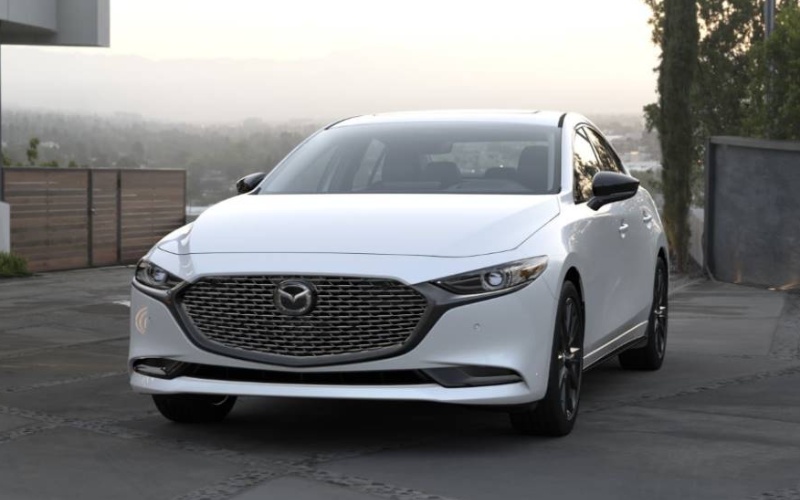
Tustin Mazda - Does the 2026 Mazda Mazda3 Sedan or 2026 Toyota Corolla feel more responsive for commuters around Irvine, CA?
Choosing between the 2026 Mazda Mazda3 Sedan and the 2026 Toyota Corolla often comes down to how each car feels in the real world — in stop-and-go traffic, on-ramps, and quick lane changes. This guide focuses on a common question: which compact sedan feels more responsive for everyday driving, and why that difference matters once you leave the spec sheets behind. We’ll examine how drivetrains, transmissions, and chassis tuning translate to confidence behind the wheel, with a clear look at available i-ACTIV AWD®, SKYACTIV®-G calibration, and Toyota Safety Sense™ 3.0 driver assists.
The Mazda3 Sedan’s responsive personality begins with its standard SKYACTIV®-G 2.5-liter engine, which provides a steady, linear build of power that pairs well with the 6-speed SKYACTIV®-DRIVE automatic. Fixed gear ratios and smart calibration deliver a direct connection to the road, particularly noticeable when merging onto busy interchanges or overtaking at speed. For drivers who value extra capability, available i-ACTIV AWD® monitors numerous inputs to help anticipate traction needs and allocate torque proactively — a system designed to feel unobtrusive yet ready the moment conditions change.
Corolla takes a different approach. The 2.0-liter gas engine and CVT emphasize smoothness and efficiency, while Toyota Safety Sense™ 3.0 provides a comprehensive assist portfolio — including Full-Speed Range Dynamic Radar Cruise Control, Lane Tracing Assist, and Pre-Collision System with Pedestrian Detection. Hybrid grades add the option of Electronic On-Demand AWD, which uses a dedicated rear motor to help when traction is limited. The result is a sedan that is easy to live with, especially if your daily routes prioritize calm cruising.
Where drivers often feel the biggest difference is in tip-in response, midrange punch, and the way each car handles quick inputs. The Mazda3 Sedan's calibration, combined with chassis technologies like SKYACTIV-VEHICLE DYNAMICS with G-Vectoring Control Plus, promotes stable weight transfer and precise steering — giving the driver an intuitive sense of control. Corolla keeps things steady and secure, but its CVT character can feel less immediate when you ask for quick acceleration.
- Acceleration feel: Mazda3 Sedan’s geared automatic provides confident kickdowns and stronger midrange response; Corolla’s CVT favors smoothness over urgency.
- AWD approach: Mazda’s i-ACTIV AWD® is predictive and always on standby; Corolla Hybrid’s Electronic On-Demand AWD engages the rear motor primarily when slip is detected.
- Steering and balance: Mazda’s tuning emphasizes natural on-center feel and calm body motions; Corolla prioritizes comfort with secure, predictable reactions.
- Driver focus: Mazda’s available Head-Up Display and tactile controls reduce distraction; Corolla’s available 12.3-inch cluster centralizes information clearly.
For most commuters, responsiveness isn’t about raw speed — it’s about confidence. Does the sedan go where you point it without drama, and does it provide the power you need at a moment’s notice? On those measures, the Mazda3 Sedan consistently earns high marks from drivers who value feedback and refinement. Corolla remains a strong option for straightforward, dependable transportation, especially if you prefer a serene, efficiency-first demeanor.
If you’d like to explore both approaches on familiar roads, schedule a back-to-back drive route that includes city traffic, freeway merges, and a stretch of winding asphalt. Bring the same playlist and take mental notes when passing, braking, and making quick maneuvers. A few miles are often all it takes to clarify which sedan aligns better with your daily routines and driving style. Tustin Mazda is here to help you tailor that evaluation, from AWD questions to feature walkarounds.
Frequently Asked Questions:
Does the Mazda3 Sedan offer an advantage in real-world acceleration?
Yes. The SKYACTIV®-G 2.5-liter engine’s linear power delivery and the 6-speed SKYACTIV®-DRIVE automatic’s fixed ratios provide a more immediate, direct response than a comparable CVT. The available 2.5 Turbo adds substantial headroom for confident merges and passes.
How do the AWD systems differ for wet or slick roads?
Mazda’s i-ACTIV AWD® anticipates traction needs using numerous sensor inputs, seamlessly distributing torque before slip is felt. Corolla Hybrid’s Electronic On-Demand AWD adds rear-axle assistance primarily when the system detects low grip, offering helpful stabilization in specific conditions.
What tech features support confident commuting?
Mazda offers an available Head-Up Display and an available Bose 12-speaker audio alongside wireless Apple CarPlay® and Android Auto™. Corolla counters with Toyota Safety Sense™ 3.0, an available 12.3-inch digital gauge cluster, and an available 10.5-inch multimedia touchscreen.
Ready to feel the difference? Plan a balanced test drive loop and compare how each car reacts to your inputs. You’ll quickly determine which sedan meets your expectations for response, comfort, and confidence — and which one you look forward to driving every day. Visit us for a professional, no-pressure comparison, serving Irvine, Aliso Viejo, and Lake Forest with tailored test routes and product guidance from a knowledgeable team at Tustin Mazda.